
Wooden Military Vehicle Models: Tool-Free Builds vs. Glued Plastic Kits
You spread the newspaper, mix the cement, and gingerly pry a tiny plastic part from the sprue. An hour later, you're still cleaning seams, and the decal sheet stares back at you like a tiny exam. For many modelers, traditional plastic military vehicle kits — such as the Academy 1:72 M1126 Stryker — deliver a finished display piece but at the cost of a messy, solvent-heavy process. There's a different way to build: a wooden military vehicle model that snaps together without a drop of glue, and still captures the heavy mechanical soul of an armored machine.
The Logicwoody line of 3D wooden puzzles flips the script on military vehicle building. Instead of painting and waiting for glue to dry, you coax a functional, moving model out of flat laser-cut plywood — using nothing but your hands and an appreciation for clever engineering.
What Plastic Military Vehicle Kits Demand
Standard injection-molded kits like the Academy Stryker, detailed over at umlconnector.com, represent the classic plastic build experience. You get multiple sprues of gray plastic, a tiny decal sheet, and a set of instructions that often require you to paint and weather the vehicle to achieve anything beyond a toy-like finish.
The reality for many builders: model cement fumes, visible fingerprints in still-soft paint, and water-slide decals that tear just as you're positioning them. The process demands patience, a well-ventilated space, and a steady hand — not to mention a collection of hobby paints, brushes, and solvents. Beginners can quickly feel overwhelmed, and even seasoned modelers sometimes end up with a kit that looks best from across the room, the micro-gaps and glue smudges hidden by distance.
Why Wooden Mechanical Models Are a Tool-Free Revelation
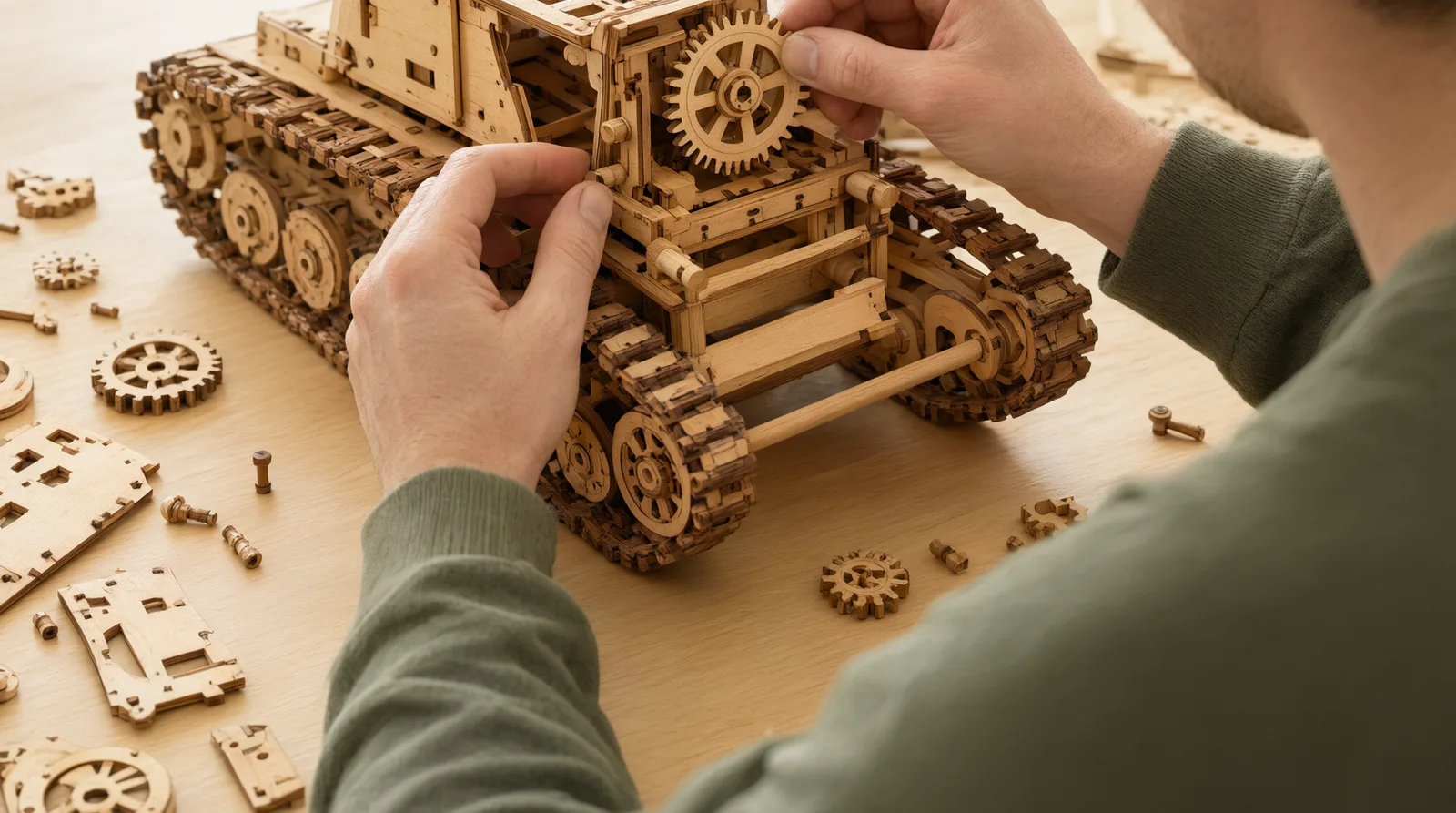
Logicwoody's approach removes the barriers that turn plastic modeling into a chore. Every kit uses precision laser-cut plywood sheets designed to lock together with a satisfying friction fit. No model cement, no paint, no water-slide decals — the natural wood grain and precisely etched details look display-ready from the moment you finish the build.
The secret is in the mechanical joinery. Flat pieces become three-dimensional forms through interlocking tabs, pegs, and in many cases, functional gears. Assembling a wooden military vehicle feels more like putting together a working machine than decorating a static hull. The process is tactile and screen‑free, and because you aren't managing chemical adhesives, you can build at the kitchen table without fumes or fuss.
Spotlight: Wooden Military Vehicle Models from Logicwoody
The Wooden Ferdinand Puzzle Classic Heavy Vehicle Mechanical Assembly is a natural entry point for fans of armored military engineering. Originally a massive German tank destroyer, the Ferdinand’s heavy silhouette and robust mechanics translate beautifully into a moving wooden replica. You build not just a shape, but a working model with rotating turret and rolling tracks — the kind of detail that stays hidden inside a glued plastic shell.
Beyond the Ferdinand, the range of heavy‑duty wooden kits includes the Wooden Belarus 82.3 Tractor with Plow, which channels the power of farm machinery into a mechanical model, and the Wooden Ambulance Puzzle, proving that emergency‑vehicle fans can also enjoy a glue‑free build. Each kit shares the same tool‑free philosophy. For a deeper look at how these models stack up against traditional plastic builds, read our guide Wooden Military Model Kits: Build & Display Heavy Vehicle Puzzles.
From Box to Shelf Without a Single Tool
Open a Logicwoody kit and you'll find everything flat‑packed and neatly labeled. The parts pop out of the plywood sheets with gentle pressure — no hobby knife, no sprue cutters required. Many kits include a small sandpaper strip for smoothing any rough edges, but the pre‑finished surfaces rarely need it.
Assembly is guided by numbered parts and clear pictorial instructions. You follow a logical sequence, watching a recognizable military form emerge step by step. Because there's no glue, you can adjust the fit of a joint in real time; a tab that's a fraction too tight can be eased in gradually, and nothing gets permanently locked out of alignment. The result is a model that sits true, with no crooked axles or canted armor plates.
The Moving Parts Make the Difference
The real payoff comes after the last piece clicks into place. Unlike a static plastic display, the Ferdinand’s mechanical assembly yields a model that actually moves: the turret rotates, the tracks roll, and the elevating gun traverses if you build in that detail. You created that movement, gear by interlocking gear, and it transforms the finished piece into a conversation starter.
Visitors instinctively want to touch a wooden model — they roll a wheel or turn a turret, and the room fills with the subtle sound of wood on wood. That interactive quality makes display even more rewarding. A simple wooden stand or an open shelf is enough; there's no fragile paint to protect from dust or fingerprints. Over time, the natural patina of the plywood deepens, giving your wooden military vehicle model a warm, lived‑in character that plastic can't replicate.
Ready to experience a military vehicle build that’s clean, mechanical, and entirely tool‑free? Browse the full 3D Wooden Puzzles collection and find the heavy machine that speaks to your inner engineer.
Frequently asked questions
Do I need glue or special tools to build a Logicwoody military vehicle model?
No. Every kit uses precision laser-cut plywood parts that snap together with friction. You don't need glue, paint, or hobby knives — just your hands. A small sandpaper strip is sometimes included to smooth an edge, but it's optional.
Are these wooden models as detailed as plastic model kits?
They focus on mechanical and structural detail rather than surface ornamentation. The gears, moving wheels, and articulated elements create a different kind of realism — you see the engineering behind the vehicle. The natural wood grain adds its own visual warmth that many builders prefer over painted plastic.
How long does it take to assemble the Wooden Ferdinand Puzzle?
Assembly times vary by builder experience, but most people complete the Ferdinand in 2 to 4 hours. The process is designed to be relaxed and meditative, so you can spread it over a couple of evenings or enjoy a single focused build session.
Can I paint or customize the wooden model if I want a different look?
Absolutely. While the plywood looks great natural, you can stain, paint, or seal it to match your display style. Because the parts lock together mechanically, you can even test-fit the entire model, then disassemble it for painting before final assembly — no glue to worry about.