
Build Wearable Wooden Armor Frames: A Mecha Model Alternative Without Glue
How a Wooden Mecha Armor Puzzle Captures the Kit-Building Rush
There’s a particular rush that hits when you snap the last armor plate onto a mecha kit—the silhouette sharpens, the frame locks into place, and a machine’s personality emerges. For anyone captivated by the XIAOT Ling Yao 1/100 kit’s fusion of ornate wuxia plating and heavy sci-fi armor, that moment is the payoff. A wooden mecha armor puzzle captures the same charge but replaces plastic sprues and glue with interlocking birch layers you assemble by hand, revealing moving mechanics that make the build feel alive.
The Ling Yao’s design philosophy, celebrated for letting builders mix ornate panel styles over a solid internal frame, mirrors exactly what happens when you work with configurable wooden puzzles. Instead of hiding seam lines under paint, you celebrate the precise edges and warm grain of laser-cut birch. Each piece pushes into place like a locking armor segment, and visible gear trains—cogs that spin, linkages that shift—become the exposed inner skeleton that plastic kits usually hide under opaque plating. The rhythmic build flow stays meditative because there are no sprues to snip, no glue fumes, and no curing time. The focus remains on mechanical fit and the tactile payoff of wood grain under your fingertips.
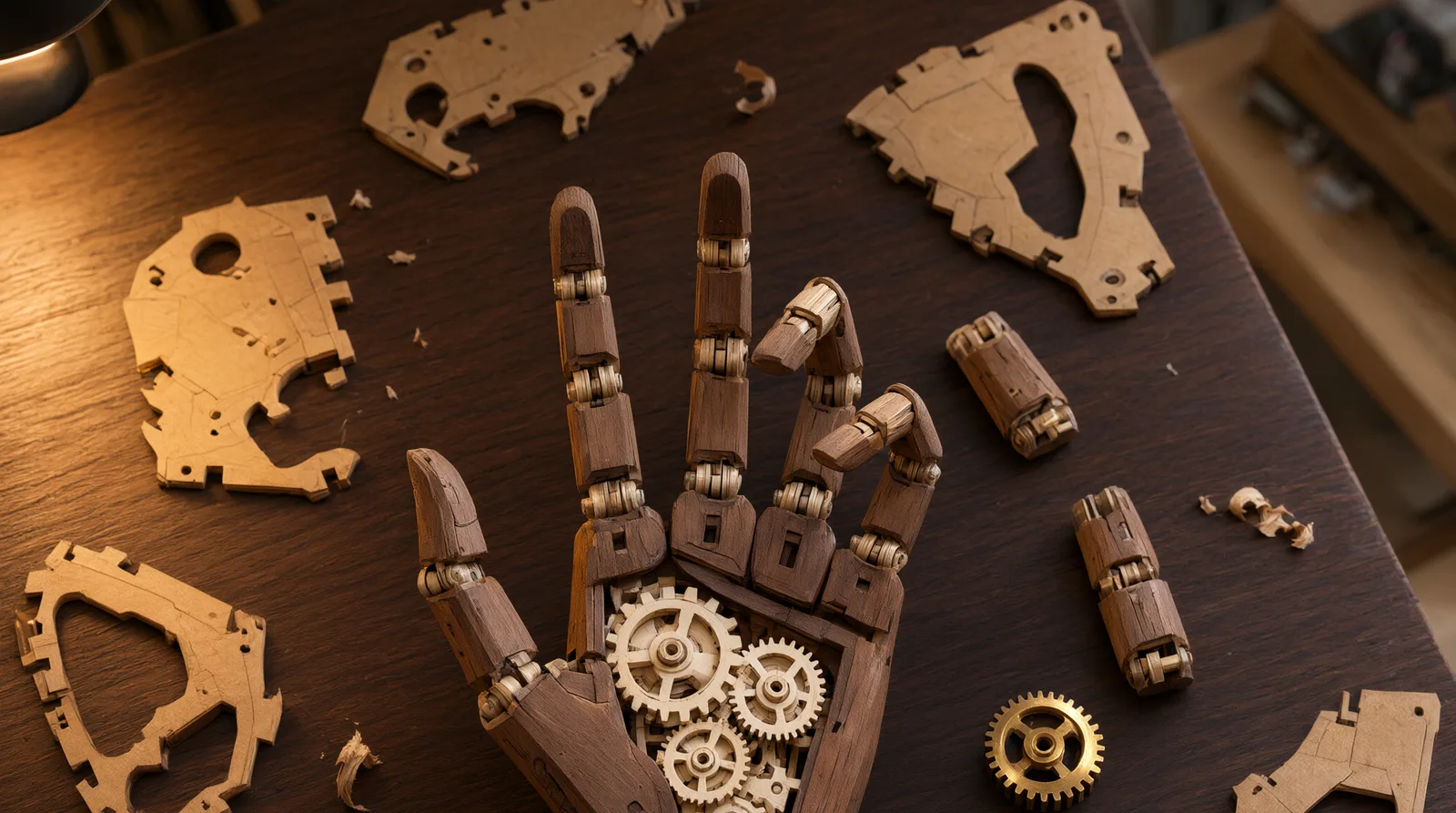
For an immediate taste of how a wooden frame transforms you into the pilot, look at the Wooden Cyber Hand Puzzle. It’s a wearable exoskeleton that straps onto your own hand, turning your movements into the trigger for clicking finger joints and rotating gear segments. That same rush of completing a static mecha build shifts into something more personal: you literally wear the armor you assembled.
The Cyber Hand and Beyond: Logicwoody's Wearable Wooden Frames
The wooden mecha armor puzzle concept becomes physical the moment you fasten the adjustable straps of a wearable cyber hand around your palm. Articulated finger sections extend across each digit, linked by exposed gear mechanisms that mimic powered armor gauntlets from your favorite sci-fi designs. Unlike a 1/100-scale static plastic figure posed on a shelf, this wooden exoskeleton moves with you: curl your fingers and the entire gear train responds, clicking through its full range of motion.
Wearability changes how you relate to the model. You’re not just an observer admiring panel lines—you become the core of the mecha, the pilot operating a frame you built piece by piece. And because the wooden components are modular and adjustable, you can tweak the fit of each finger segment without risking a ruined paint job. On a resin or plastic kit, a single modification might mean sanding, priming, and repainting an entire limb. Here, you simply adjust the strap or reposition a linkage. The natural birch surface already looks finished—its pale, utilitarian tone reads like raw prototype armor or a desaturated mecha variant straight out of the box.
Browsing the broader 3D Wooden Puzzles collection reveals that this wearable approach extends to other configurable builds. The same interlocking logic that frames your hand also shapes the layered hull of a wooden vessel or the structural chassis of a heavy vehicle model. Each demands a similar mindset: assemble a skeleton, attach outer plates, and leave the mechanics visible.
Marble Runs and Gear Tracks as Mechanical Spine and Core Armor
Every memorable mecha design relies on an internal skeleton that supports layered outer armor. In Logicwoody’s world, that skeleton often takes the form of interlocking gear tracks and load-bearing rail systems. Building a wooden marble run puzzle—like the Wooden Marble Run Puzzle Mechanical Gear Track Logic Game—teaches exactly the same structural layering logic as placing armor plates over a frame. Each tier of track supports the next; remove one layer and the whole kinetic spine would collapse. You assemble cogs, ramps, and columns in sequence, seeing how the load transfers from piece to piece, just as you’d build an inner frame before adding shoulder pauldrons or chest plating on a plastic mecha.
The display factor seals the connection. Once complete, a wooden gear-track model shows off its entire mechanical system—spinning gears, rolling marbles, shifting levers—like a transparent armor variant in a plastic kit series. Nothing is hidden behind solid panels. That raw visibility matches the “open hatch” or “clear parts” aesthetic that Gunpla and other mecha builders chase with aftermarket photo-etch and translucent resin. Here it comes as the default state, assembled from warm birch plywood that catches light differently than injection-molded plastic.
The Tools-Free Advantage for Armor-Like Layered Builds
Resin mecha kits demand a full toolkit: sprue cutters, sanding sticks in multiple grits, cement, putty for seam filling, primer, and an airbrush setup if you want a clean finish. A wooden mecha armor puzzle strips all of that away. Logicwoody’s pieces arrive laser-cut and push-fit, so you achieve flush, layered-armor joints with nothing but your hands. The edges align with a satisfying friction lock, and because wood forgives tiny misalignments with its natural slight compressibility, you’re not chasing the absolute perfection that brittle resin requires.
This tool-free assembly radically lowers the barrier to a layered-armor aesthetic with clean mechanical detail. You don’t need to paint anything to make it display-ready. The natural birch tones suggest a raw prototype or a utilitarian armor variant—think of the unpainted “rollout” color schemes seen in real-world mecha prototypes before livery is applied. If you ever do want to personalize the wood, a light stain or wax deepens the grain without the multi-day process of priming, base-coating, panel-lining, and top-coating. But the point is you never have to. The puzzle arrives complete in material character the moment you punch out the first sheet.
Mixing Wooden Mechanical Models to Create Your Custom Armor Display
One standalone wearable makes a statement, but combining multiple wooden mechanical models builds an entire cohesive world on your shelf—much like collecting different mobile suit variants from the same mecha universe. Pair the wearable cyber hand with gear-driven desk models that share its visual language of exposed cogs, articulated joints, and structural frames echoing layered plating. For instance, the Wooden Printing Machine Puzzle Mechanical Movable Type Model Kit brings a complex sequential mechanism alive: turn the handle and watch type blocks press in order, revealing the same kind of timed mechanical logic that governs a mecha’s moving armor panels.
Place it beside a heavy vehicle or tractor unit model, like the Wooden Tractor Unit and Container Chassis Set or the Wooden Belarus 82.3 Tractor with Plow Farm Machinery Model Kit. These builds share the mechanical logic—chassis frames, pivoting hitches, rotating drivetrain elements—that resonates with the inner workings of a mecha’s hip joints or articulated backpack arms. The agricultural and construction veneer becomes irrelevant; what matters is the structural language. A curved wooden gear housing on a forage harvester reads just like a mecha’s knee armor. The Wooden FS80 Forage Harvester with JKS 4.5 Header Farm Model Kit demonstrates this beautifully with its layered header assembly and exposed drive mechanisms.
Scale mixing works in your favor. A wearable cyber hand at center stage, flanked by a desktop marble run that acts as a “power core” and a tractor unit as a “ground support frame,” creates a display that tells a mechanical story no single plastic kit can. Browse the full 3D Wooden Puzzles collection to identify which builds share the gear train and layered-frame DNA you want in your custom armor world.
Why Wood Earns a Spot in a Plastic Mecha Builder's Collection
Mixed-material displays are not a compromise anymore—they’re a deliberate curatorial choice. Collectors increasingly place wooden, metal, and cloth elements alongside their injection-molded figures to create contrast in texture and mass. A completed wooden mecha armor puzzle makes that contrast impossible to ignore. Where a plastic kit’s surface feels homogeneous and slightly slick, birch plywood adds an organic grain and a warmer, slightly softer touch. The two materials side by side—say, wearable wooden gauntlets next to a painted resin Gundam—heighten the appreciation for both.
Then there’s the interactive dimension. A static plastic armor display holds its pose. A finished wooden puzzle moves. Spin the gear on a printing machine, send a marble through its track, wiggle the fingers of a cyber hand—these aren’t just sculptural objects, they’re functional mechanisms. That kinetic ability provides a fidget-friendly satisfaction that no snap-fit plastic armor display can replicate. And building one wooden mechanical model often triggers the same customization and iteration urge that keeps plastic kit builders returning to the workbench. You’ll finish the cyber hand and immediately wonder how its finger mechanism could be adapted to a desktop catapult or a clockwork timer. That open-ended tinkering spirit mirrors the best of mecha modeling culture.
The direction woodcraft designs are heading only deepens the overlap. Upcoming releases continue to explore wearable frames, configurable joints, and armor-inspired layered assemblies that speak directly to anyone who loves the engineered feel of a mecha kit but craves a natural material and glue-free process. Keep an eye on the 3D Wooden Puzzles collection for new arrivals that push that boundary further.
Frequently asked questions
What is a wooden mecha armor puzzle, and how does it compare to a plastic mecha kit?
A wooden mecha armor puzzle is a laser-cut birch assembly that mimics layered armor frames, exposed gears, and articulated joints without any glue, paint, or plastic sprues. Unlike injection-molded mecha kits that require tools and finishing work, these puzzles use push-fit construction to create wearable or display-ready mechanical models with a raw, utilitarian aesthetic.
Do I need tools or paint to build Logicwoody’s wearable wooden models?
No. All pieces are laser-cut and push-fit, so you assemble them with your hands alone. The natural birch surface looks finished straight out of the box, eliminating the need for priming, painting, or top-coating. If you choose to customize later, a light stain or wax is optional.
Which Logicwoody products are closest to a wearable mecha armor build?
The Wooden Cyber Hand Puzzle is a fully wearable exoskeleton gauntlet with articulated fingers and exposed gear mechanisms. Other configurable builds like the Wooden Printing Machine Puzzle and Wooden Marble Run Puzzle share the layered-frame, visible-gear design language that resonates with mecha armor customization.
Can wooden mechanical puzzles be combined to create a themed mecha display?
Absolutely. Pairing the wearable cyber hand with gear-driven desk models—such as a tractor unit, printing machine, or marble run—builds a cohesive mechanical world on your shelf. The shared visual language of exposed cogs, articulated joints, and structural frames echoes the layered plating of modern mecha designs.