
Inside the IndyCar Chassis Test: What a Wooden Chassis Model Teaches You
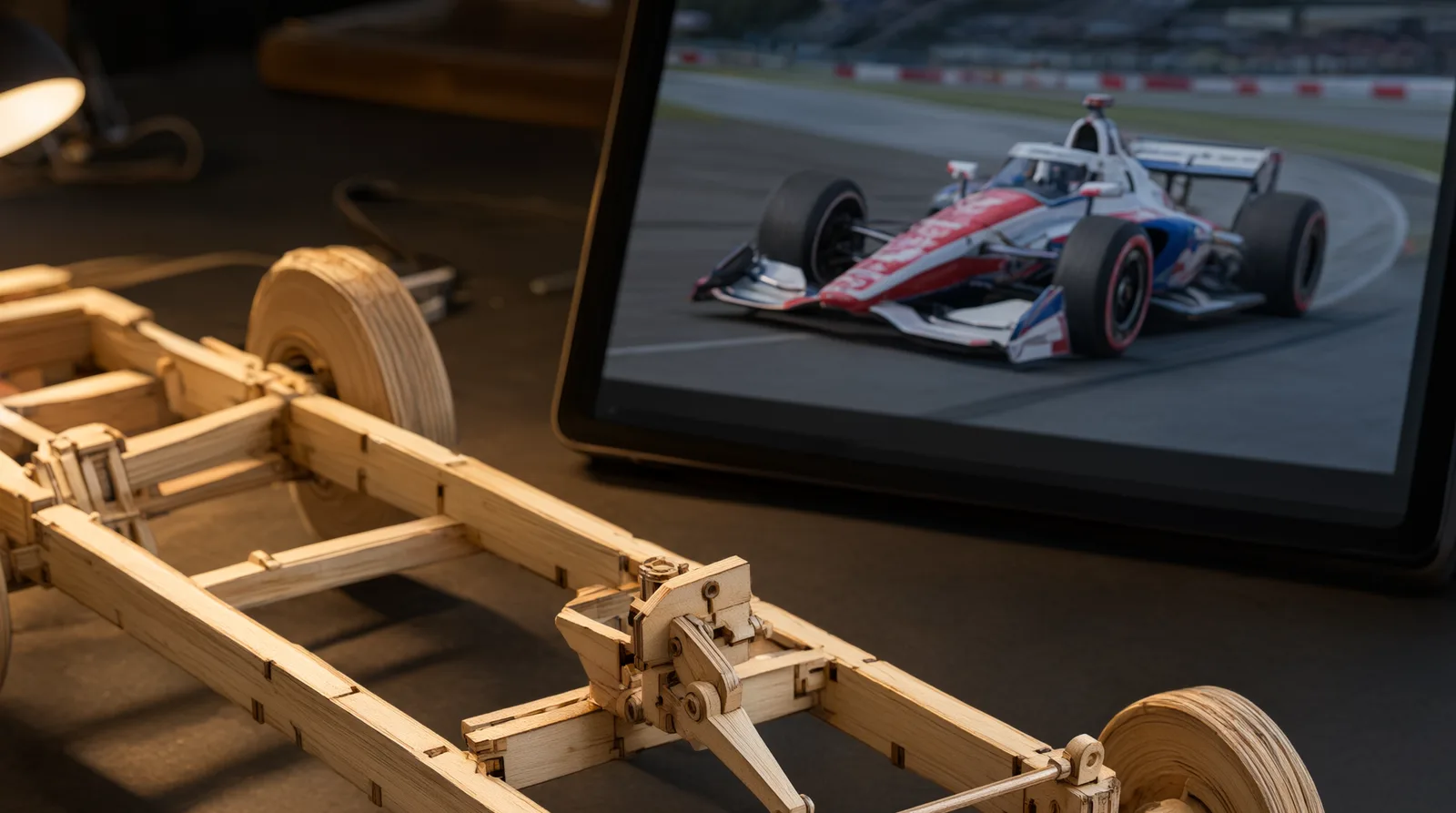
The news that a new IndyCar chassis is headed into further evaluation next week has fans and engineers alike talking about what separates a great race car from a good one. While an actual carbon-fiber monocoque isn't something you can bring to your workbench, a wooden race car chassis model—in the form of a detailed tractor unit puzzle—can teach you the very same principles of rigidity, load paths, and steering geometry that define that next-generation design.
The upcoming test, reported by Motorsport Week, will validate the chassis tub and suspension geometry for safety, stiffness, and aerodynamic integration. That might sound like a closed world reserved for engineering teams, but the core ideas are far more accessible than you might expect. All you need is a laser-cut wooden kit and a few hours of assembly to start seeing why a chassis is the soul of any vehicle, whether it's lapping a circuit or hauling a container across the country.
What the New IndyCar Chassis Evaluation Actually Means
A chassis evaluation isn't a single test; it's a series of trials that probe how a car's structure holds up under cornering loads, impacts, and the constant vibration of track use. Engineers look at torsional stiffness—the frame's resistance to twisting—because every bit of flex dulls the driver's connection to the road. They analyze how suspension pickup points transfer forces, and they ensure the tub can protect the driver without adding unnecessary weight.
These concepts aren't exclusive to open-wheel racing. A tractor unit chassis, a heavy-duty truck frame, or even the box-section body of an ambulance all share the same engineering DNA: a structure that must be strong where it carries load, rigid where it locates wheels, and compliant enough to survive real-world abuse. When you build a wooden kit that replicates those frames, you're not just making a model—you're physically tracing the logic that an IndyCar design team uses, one cross-member at a time.
Why a Wooden Race Car Chassis Model Starts with a Tractor Unit Puzzle
The Wooden Tractor Unit and Container Chassis Set is the ideal entry point for anyone who wants to understand chassis architecture. Its ladder-frame design is the same basic pattern that underpins heavy trucks and, in a more evolved form, the backbone of a race car's monocoque. As you fit the laser-cut plywood rails together with the cross-members and suspension mounting points, you feel exactly how each piece contributes to overall rigidity.
What makes this kit so instructive is the visual separation between the load-bearing frame and the container body. In a race car, the bodywork is largely an aerodynamic shell wrapped around a central tub or spaceframe; here, the tractor chassis does the heavy lifting while the container sits on top. By building both elements, you come away with an intuitive grasp of why a chassis is designed to manage stress independently of the body it carries. It's the same foundational lesson an IndyCar engineer learns, scaled down and placed in your hands.
Comparing Frame Types: Ladder, Monocoque, and What Wood Can Show You
For a hobbyist, two frame types matter most: body-on-frame (think classic pickup trucks and the Logicwoody tractor kits) and monocoque/unibody (modern race cars and most passenger vehicles). A body-on-frame design places a separate chassis under the body, while a monocoque integrates the body and frame into a single stressed shell. The magic of a wooden puzzle is that it lets you explore both ideas even if the final subject is a venerable farm machine.
When you assemble the Wooden Ferdinand Puzzle or the Wooden Belarus 82.3 Tractor with Plow, you're handling a classic heavy-vehicle frame where the main rails do all the work. But the very process of snapping thin plywood panels together to form a rigid box also teaches the stressed-skin principle—because you can see how each panel locks into its neighbors to create a strong, self-supporting structure. The Wooden Ambulance Puzzle takes this further, showing how a box-section body acts as its own frame while still relying on a lower chassis for suspension mounting. No textbook diagram can replace the moment when you slide a wooden cross-member into a precisely cut slot and watch the whole assembly stiffen up.
Steering, Linkages, and Suspension Geometry You Can Build with Your Hands
Once you've mastered a static frame, the next step is making it steer. The Wooden Tractor Unit and Tanker Semi Trailer Set adds a functional kingpin and fifth-wheel coupling, creating a pivot system that echoes how a race car's suspension must articulate while keeping the tires planted. Turning the steering wheel on this model moves a physical linkage, and as you watch the tie rods push and pull the front wheels, you start to recognize the Ackermann geometry that ensures the inside wheel turns sharper than the outside one.
Many builders first discover these ideas through RC or plastic kit chassis, which is why the blog post Tamiya Chassis Fever? Try a Wooden Tractor Puzzle Kit Instead resonates so strongly with this crowd. The transition from snapping together plastic suspension arms to assembling real plywood pivots feels like upgrading from a schematic to a working prototype. After you've tuned the steering on a tractor, you'll be well prepared to appreciate the articulated steering of the Wooden MoAZ 75053 Earthmoving Dump Truck or the compact, high-strength pivot points on the Wooden MoAZ 4075 Load Haul Dump—both part of the wider 3D Wooden Puzzles collection that turns machinery into mechanical teachers.
From Truck Chassis to Race Car Thinking: How the Build Changes Your Eye
Build a rigid frame and a working steering assembly, and the next time you watch an IndyCar onboard replay, you'll see it differently. Every steering input, every curb strike transmitted through the suspension, starts to feel like a conversation between the driver and a structure you've touched with your own fingers. The chassis stops being a black box and becomes a set of load paths you can visualize.
This isn't limited to tractor units. The Wooden FS80 Forage Harvester with JKS 4.5 Header is a standout example: its complex driveline and header attachment demand a chassis that can handle twisting forces while staying aligned, proving that even farming equipment depends on the same fundamentals. Every model in the Logicwoody lineup—whether it's a transport truck, a construction machine, or a nautical vessel—is an opportunity to explore how mechanical principles transfer across scales and purposes. And right now, as the real IndyCar paddock prepares for that next evaluation, the lesson is clear: a great chassis isn't just about speed, it's about clarity. When you build one in wood, you start to feel that clarity for yourself.
Displaying Your Wooden Chassis Model and Where to Go Next
Once the build is complete, how you display the model can highlight the engineering inside. Leave one side of the tractor unit unplanked so the frame rails and steering linkage remain visible, or set the tanker semi-trailer at an angle that shows off the fifth-wheel articulation. A simple clear acrylic stand can elevate the chassis and turn a shelf into a conversation piece.
For a pure mechanism-focused next build, the Wooden Printing Machine Puzzle delves into moving type logic, while the Wooden Marble Run Puzzle explores structural path planning and the physics of gravity. If you're ready to move from vehicle chassis to something entirely different but equally mechanical, the earlier post on wooden mechanical robot kits shows how linked segments and pivot joints follow the same rules you've just mastered. The entire 3D Wooden Puzzles collection is here for you—every kit a chance to see engineering principles stand up on your shelf and, just maybe, change the way you watch a race.
Frequently asked questions
Does Logicwoody sell a dedicated wooden race car chassis model?
Logicwoody's lineup focuses on heavy truck, farm, and construction machinery, not literal race cars. However, the Wooden Tractor Unit and Container Chassis Set and similar builds reproduce the core chassis fundamentals—ladder-frame rigidity, load distribution, and steering geometry—making them authentic hands-on learning tools for anyone curious about race car engineering.
Which wooden model is the best starting point for learning chassis design?
The Wooden Tractor Unit and Container Chassis Set is the best starting point because its ladder-frame construction clearly shows how a chassis carries weight and resists twisting forces. Pair it with the Tanker Semi Trailer Set to add functional steering articulation, and you'll cover the three essential lessons: static structure, load separation, and mechanical linkages.
Can I customize these wooden kits to make them look more like a race car?
The kits are precision-cut for their real-world vehicle designs, so significant alterations are difficult. The educational value is in understanding the principles, not the final appearance. A tractor unit's frame teaches the same concepts of triangulation, pivot geometry, and stress paths that apply to a race car, meaning you gain knowledge that transfers even if the model stays true to its truck identity.
How well can a wooden model demonstrate structural concepts like torsional rigidity?
Yes. The plywood pieces form a surprisingly sturdy assembly. While they're not designed for heavy loads, you can gently flex a finished ladder frame to feel how cross-members resist twisting, or simply observe how the structure stays square without glue when all joints are tight. It's a tactile lesson in torsional stiffness that no diagram can match.